Find out where AI will pay off in your business — in one hour.
A practical workshop for your leadership team, built on your own numbers. Fifteen minutes of pre-work, a sixty-minute decision, and a plain-English brief that names where to start, what is in the way, and the risks already running.
Your team is already using AI. The question is where it should pay off.
In most businesses we talk to, someone is already drafting quotes, emails or reports in a free AI account. Nobody decided that, and nobody knows what data went in. That is not a reason to panic — it is a reason to spend one hour getting a clear, shared answer.
Nobody has added up where the time goes
The routine work that eats hours every week — quotes, reports, checks, packs — has never been put on one page with a cost next to it.
Vendors are pitching, but priorities are unclear
Without your own numbers, "where do we start?" becomes a debate about opinions and demos.
Risk is already running, unseen
Personal accounts, AI features switched on inside existing software, trials nobody closed — usage is happening before the rules are.
How a session runs, in under two minutes.
The pre-work, the brief, the workshop — onsite or over Teams — and the report-out, start to finish.
Illustrative example — Karoo Logistics is a fictional company. Workshop footage from Proven Path sessions.
Five steps, about two weeks, one clear first move.
Most of the thinking happens before you are in the room, so the hour is spent deciding — not collecting information.
Agree the session
A short call to agree who attends, the date, and whether we meet in person or online.
Pre-work questionnaire
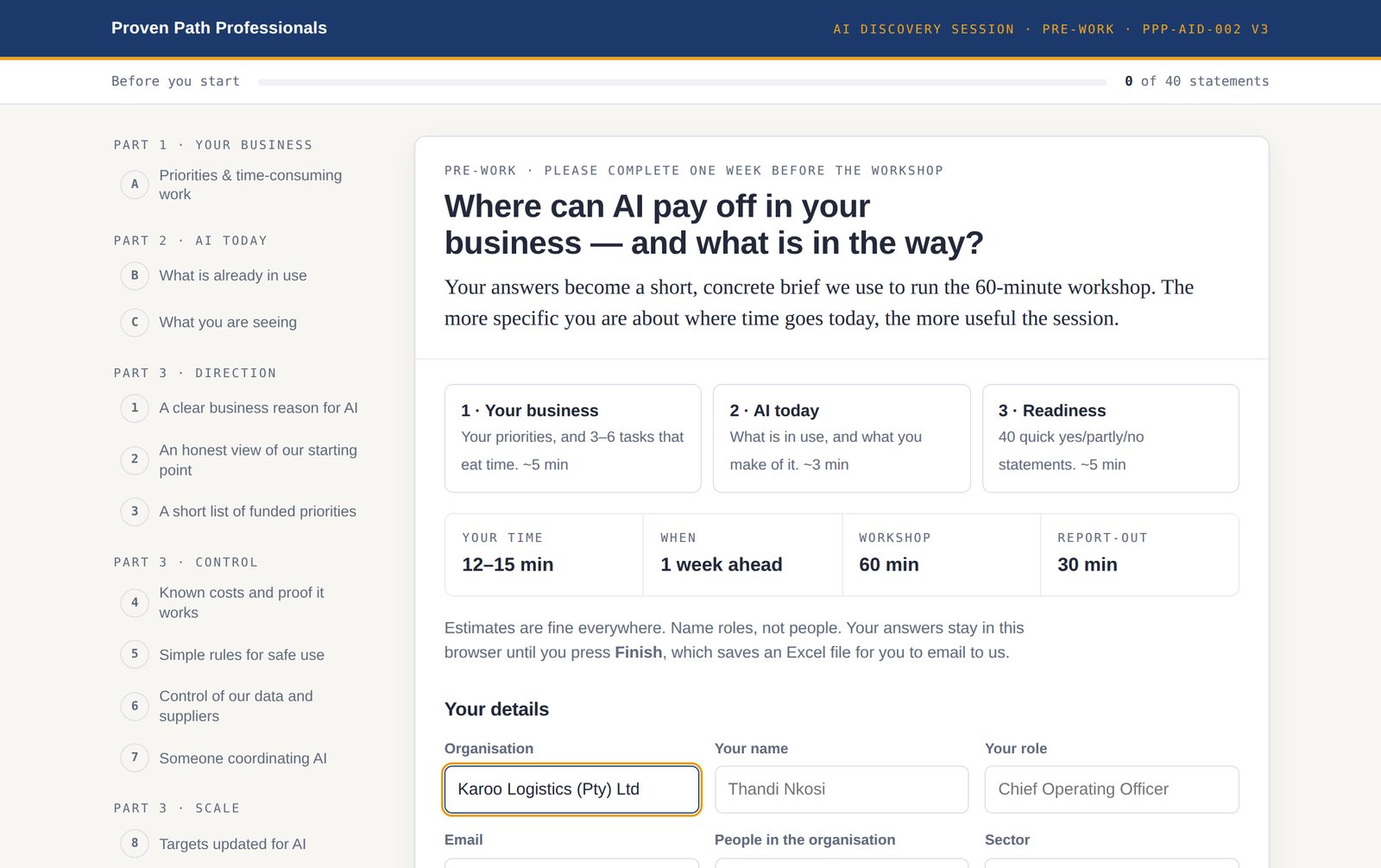
One person completes a short online questionnaire. Estimates are fine; roles, not names.
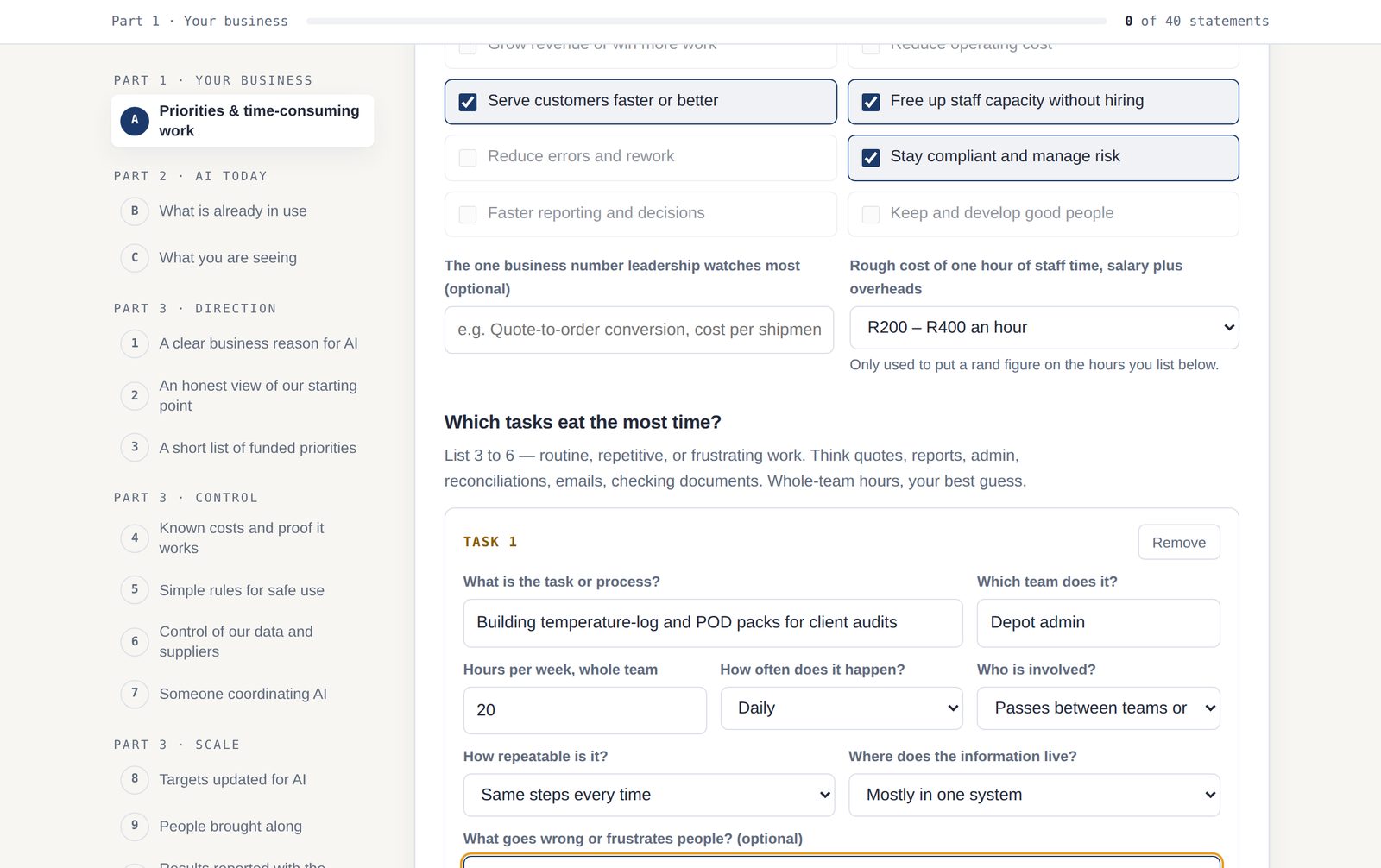
- Priorities & time-consuming tasks
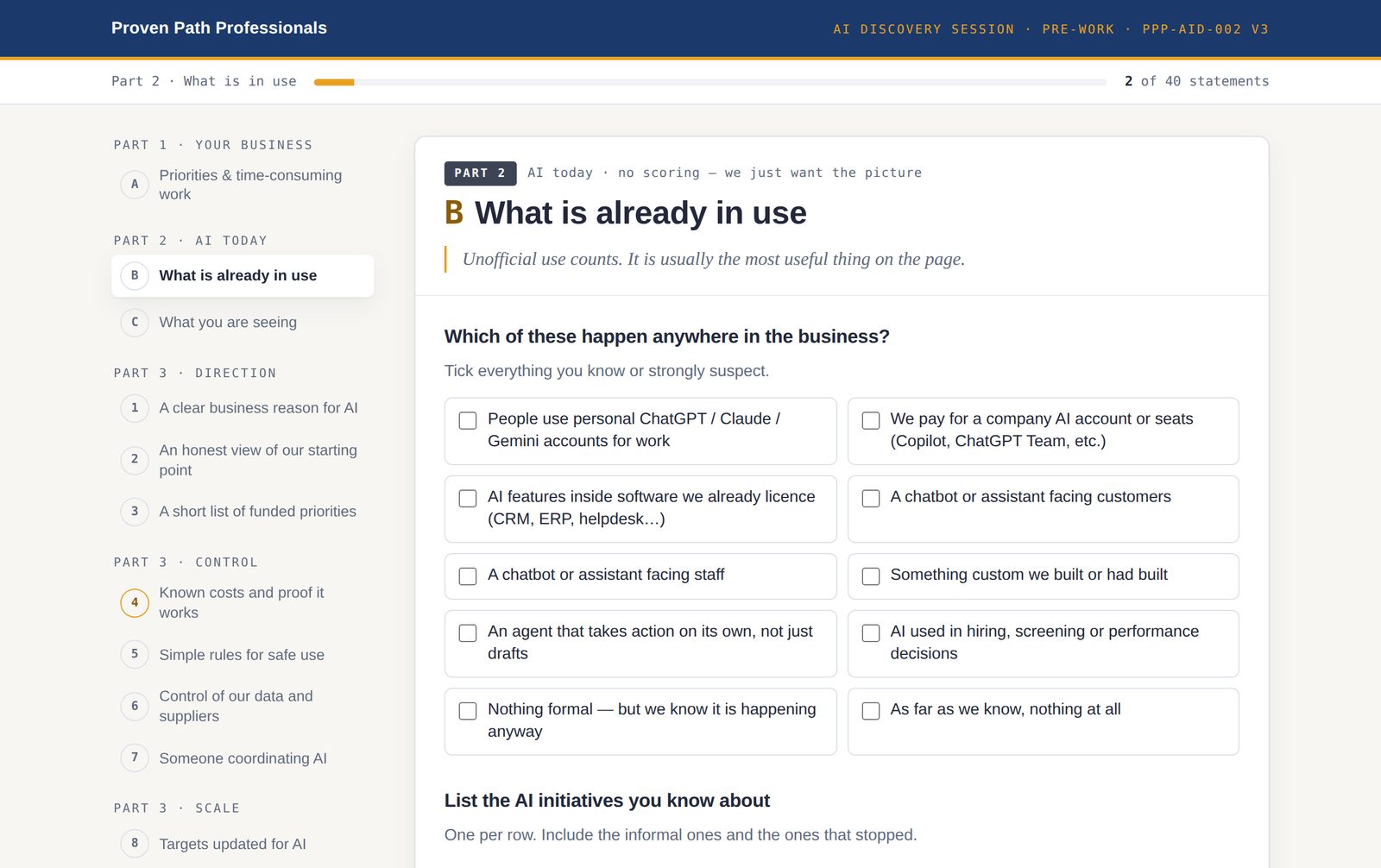
- AI already in use
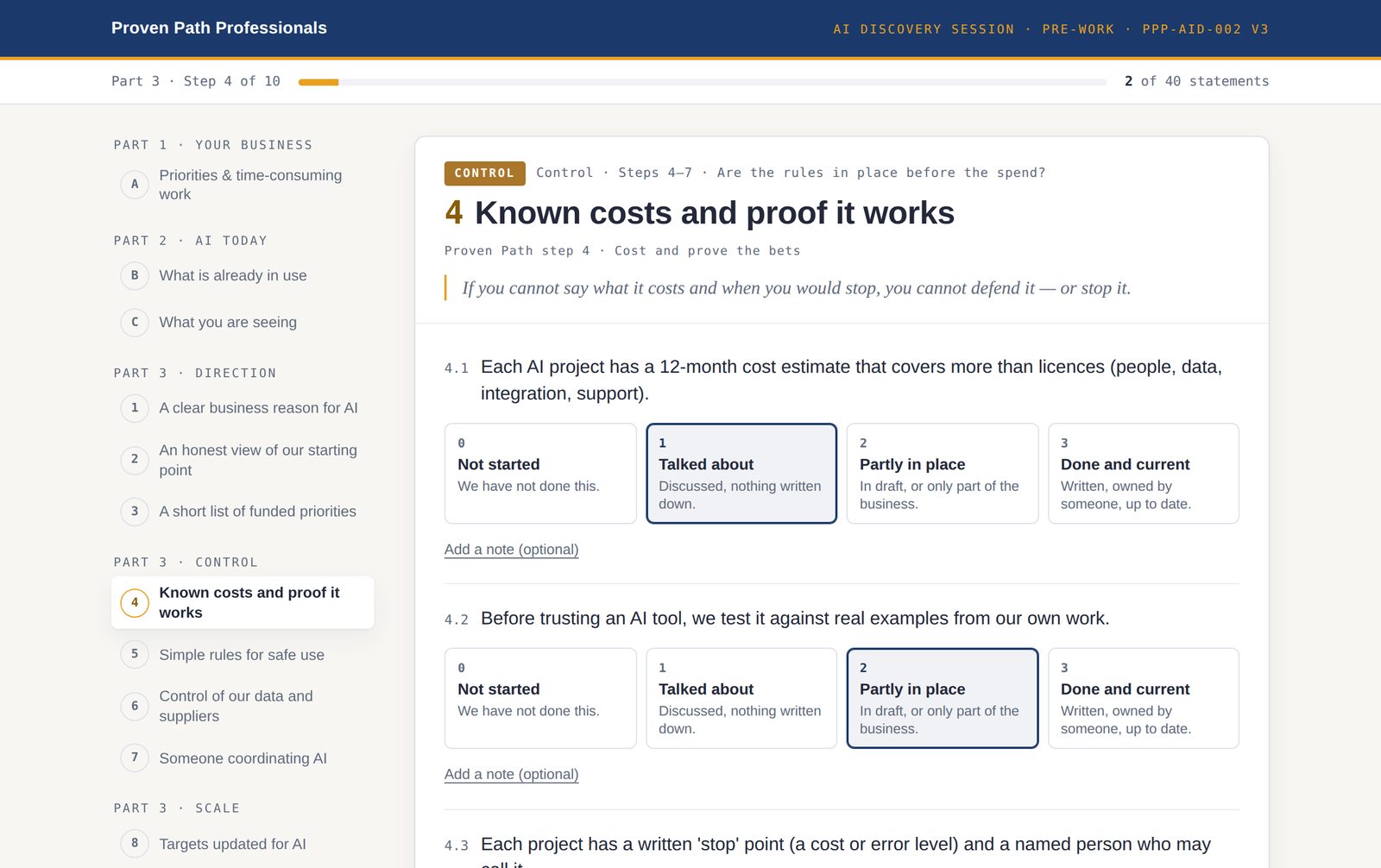
- 40 quick readiness statements
We build your brief
We score your answers, cost each task, place it on one map, find your weakest area, and plan the hour.
The workshop
We walk the top tasks, show AI working live on one of your own documents, and decide.
- One task to prove value
- One owner, one date
- A call on AI already in use
Report-out
The final brief — updated with the scores, owners and decisions agreed in the room — walked through with you.
A questionnaire built to be answered in one sitting.
It runs in the browser, saves as you go, and produces a file you email back. Nothing is shared until you press Finish. Here is what it asks.
Direction Areas 1–3
Is AI a business decision, with a reason and priorities?
- 1A clear business reason for AI
- 2An honest view of our starting point
- 3A short list of funded priorities
Control Areas 4–7
Are costs, rules, data and ownership in place before the spend?
- 4Known costs and proof it works
- 5Simple rules for safe use
- 6Control of our data and suppliers
- 7Someone coordinating AI
Scale Areas 8–10
Is AI becoming part of targets, people plans and reporting?
- 8Targets updated for AI
- 9People brought along
- 10Results reported with the financials
The weakest area caps the rest. We do not hide a gap behind an average. The report leads with your lowest-scoring area, what it is costing you, and what "good" looks like — because that is the floor under everything else you try.
The brief: your numbers, on one map.
Prepared before the workshop and updated after it. Here are four pages from a worked example — click any page to read it.
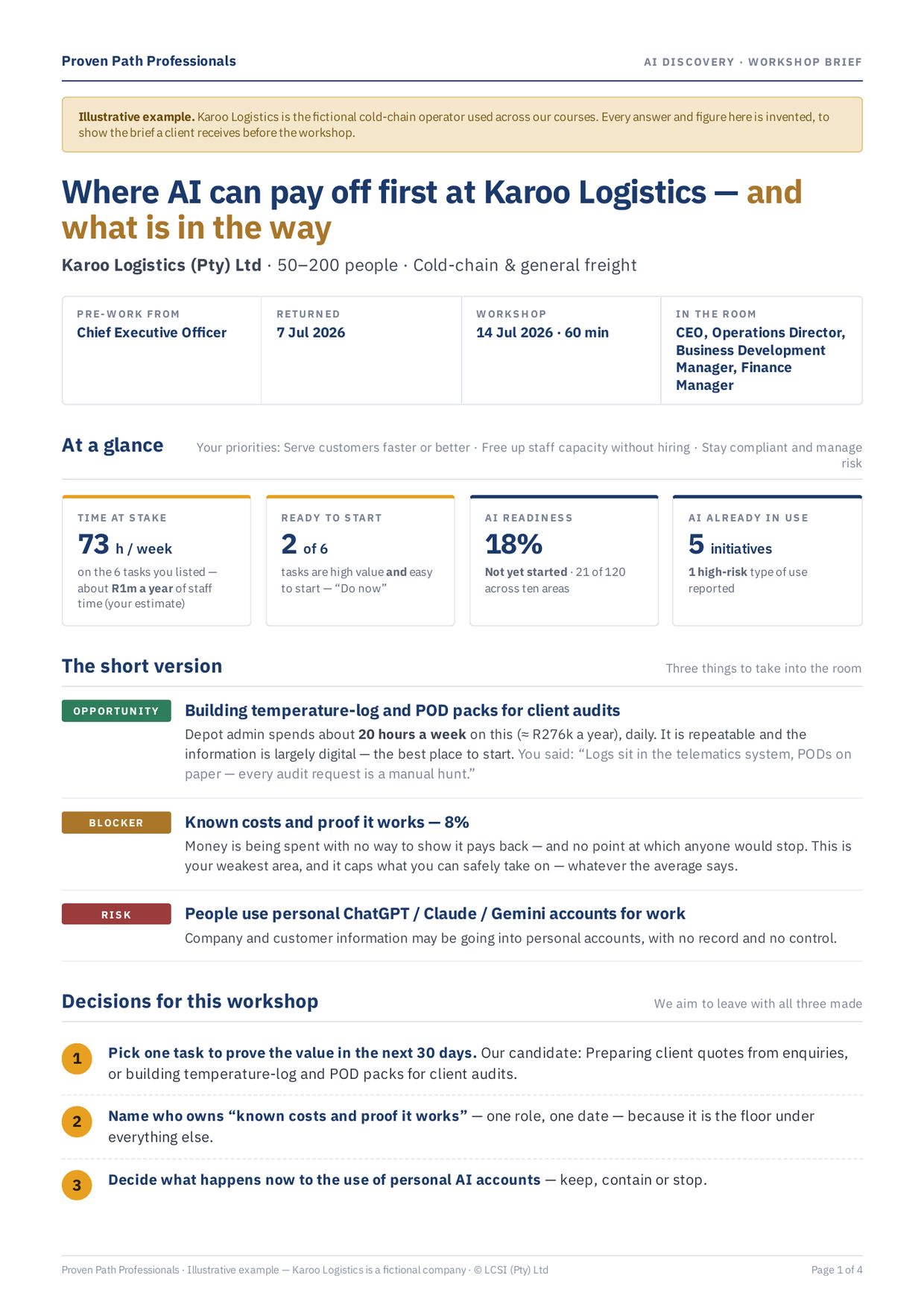
Time at stake, what is ready to start, overall readiness, and the three things to take into the room: an opportunity, a blocker and a risk.
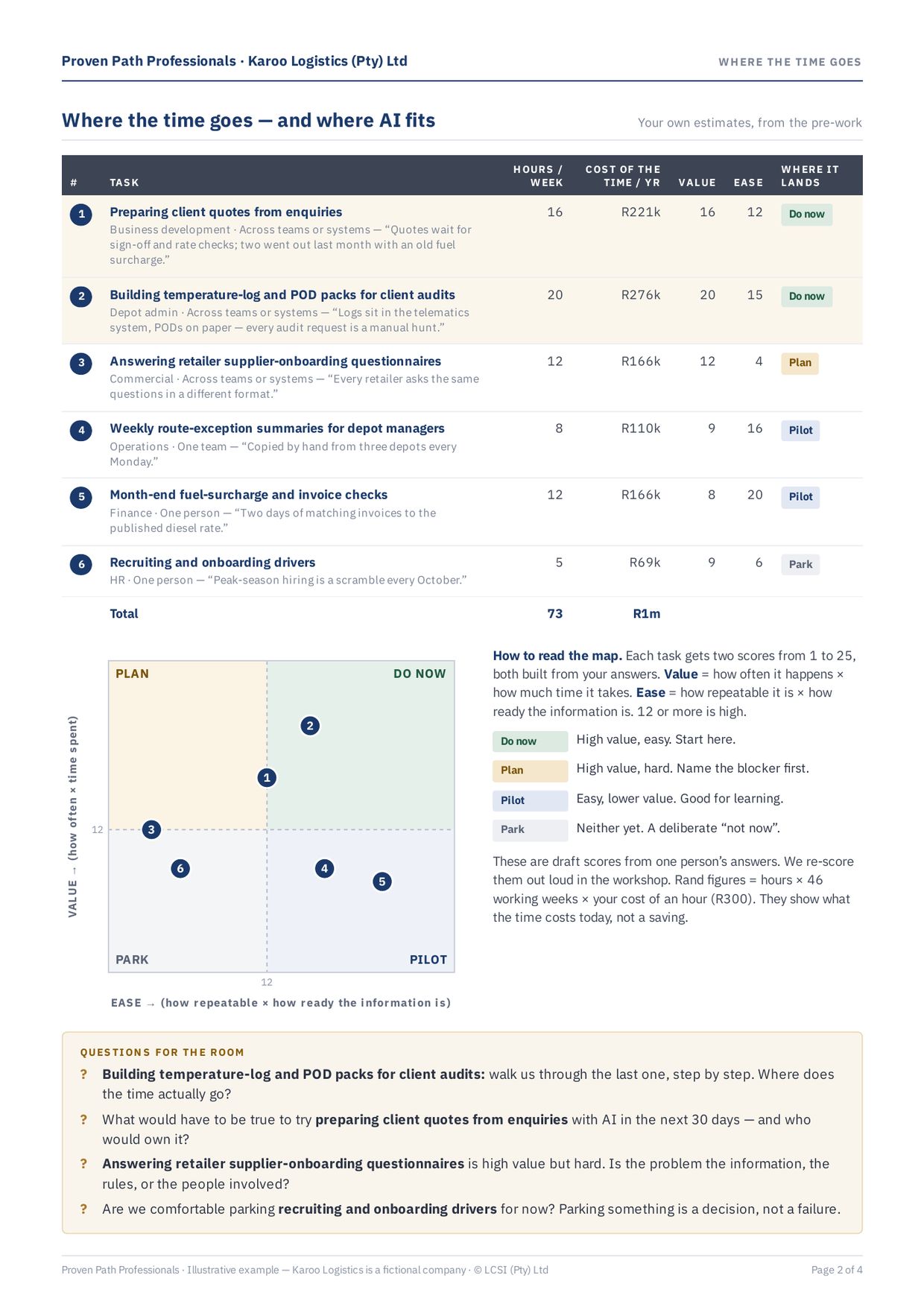
Every task you listed, costed from your own estimates, scored for value and ease, and placed on one map — with questions for the room.
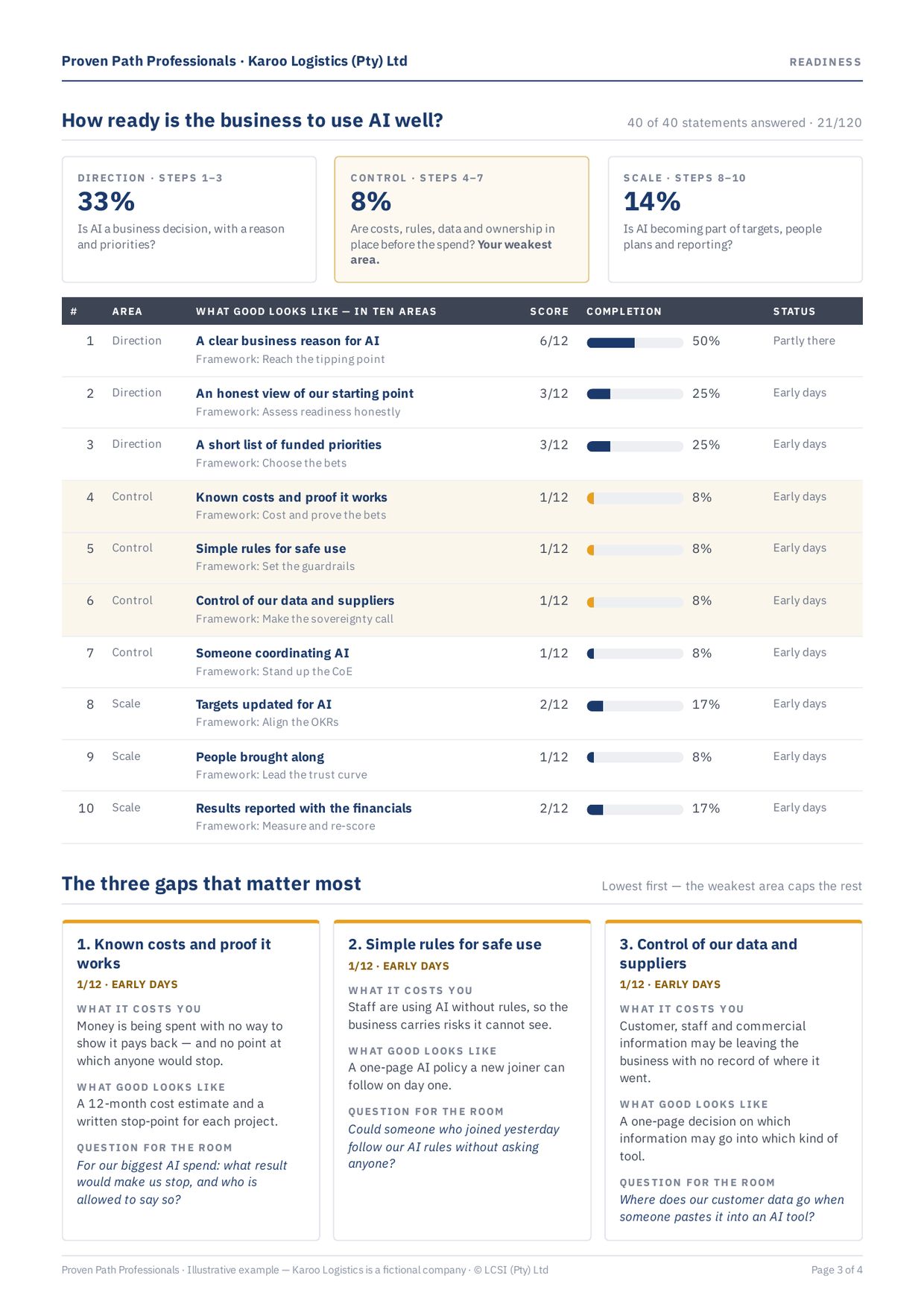
Scores for Direction, Control and Scale, and the three gaps that matter most — what each costs you, what good looks like.
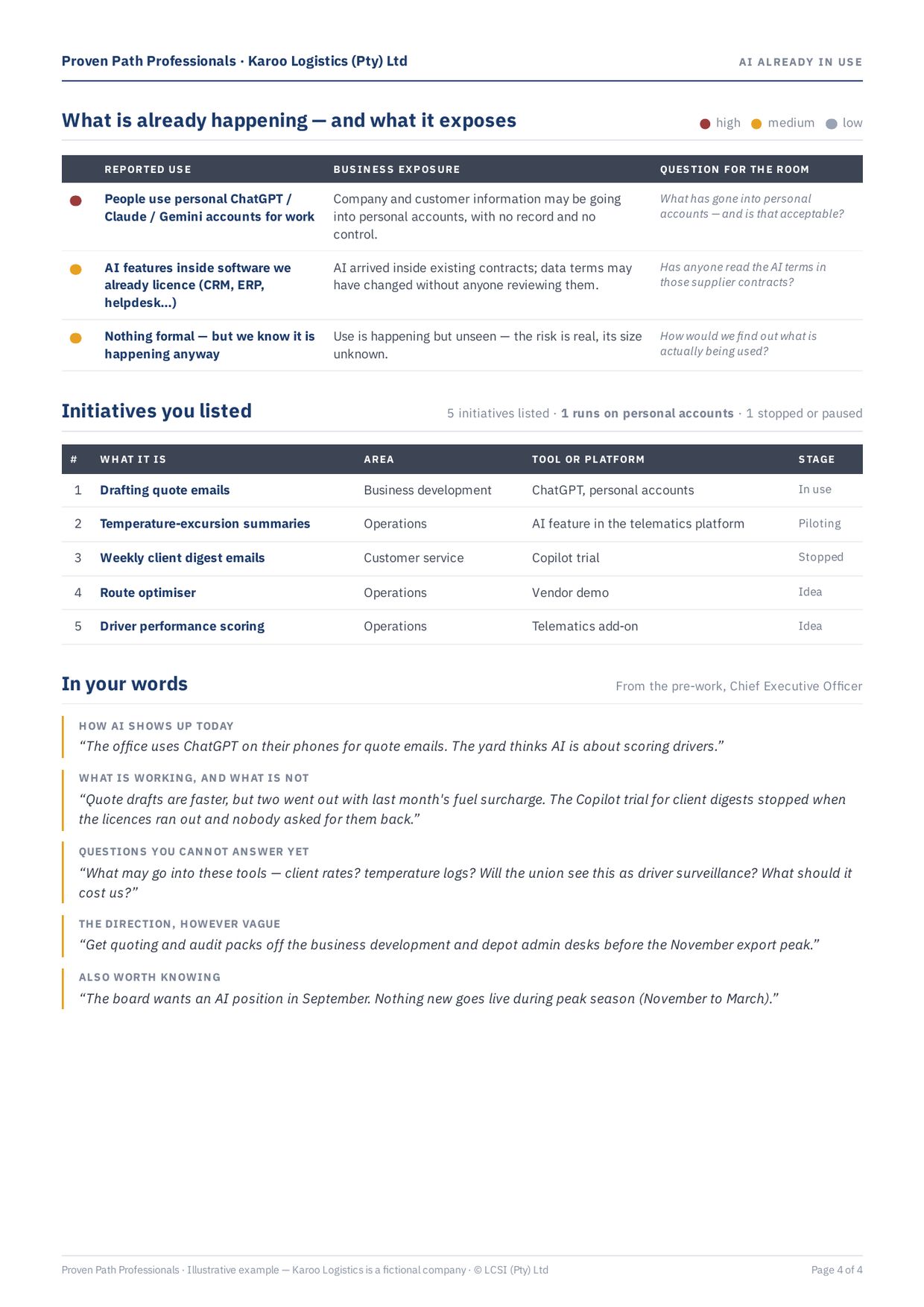
What is happening today, the exposure each use creates, every initiative you listed — and your own words, kept as you wrote them.
It takes the argument out of "where do we start?"
Each task gets two scores, both built from your answers. Not every task should get AI — some should be parked, on purpose.
- Your figures, not ours. Hours come from you; the cost is hours × working weeks × your own cost of an hour.
- What time costs today — not a promised saving. We never put a saving on paper that you did not estimate.
- Draft scores, re-scored out loud. The map is a starting point for the room to agree, not a verdict.
Honest by design.
Your numbers
Everything on the page comes from your answers — not vendor benchmarks or industry averages.
"Not yet" is an answer
If the numbers do not justify a next step, the report says so. Parking something is a decision, not a failure.
Confidential
We use only what you choose to share, name roles rather than people, and sign an NDA on request.
Decisions, not decks
You leave with one task to prove, one owner, one date — and a clear call on the AI already in use.
Questions people ask before they book.
Do we need to be "doing AI" already?
No. Most clients have a few people on free tools and no plan. That is where the hour is most useful.
Is this a sales pitch for training?
No. One possible answer is "nothing yet". If the numbers do not justify a next step, the report says so.
Who should attend?
The leadership team — usually 4 to 10 people, including whoever owns the processes on the task list.
How much of our time does it take?
About 15 minutes of pre-work for one person, 60 minutes for the team, and 30 minutes for the report-out.
What about confidential information?
We only use what you choose to share, we name roles rather than people, and we sign an NDA on request.
Where do the cost figures come from?
From you: hours a week × 46 working weeks × your own cost of an hour. They show what the time costs today, not a promised saving.
Our IT team is handling AI. Is this still relevant?
Yes — bring them. This is about business priorities and risk, which is a leadership decision; the IT view makes the map better.
What happens after?
A clear recommendation for the next step — for example a hands-on training day for a team, or a leadership day to settle policy and priorities — or honest advice to wait.
One hour. Your numbers. A clear first step.
If your leadership team keeps circling the AI question, book a free 15-minute call. We'll tell you honestly whether a Discovery Session is the right first step — in person or by video, wherever you are.